
It was 10 PM on June 19th, and in true Alaskan fashion, was still light outside. I hopped off an aging yellow school bus with 50 of my coworkers as a few raindrops pelted my face. A cool breeze blew in from the ocean to the west, sending a shiver through my body. Overcast skies made the boats and storage containers that filled a massive dirt lot across the street seem eerie, even sinister. After 20 hours of travel, which included one car ride, three flights, and 45 minutes on a rickety school bus, I had arrived at Leader Creek’s facility in Naknek.
We unloaded in front of a massive two-story building with blue aluminum siding and white trim. The property had two dorms numbered 14 and 20. Dorm 14 would be my home away from home for the length of my employment contract.
Members of the human resources team asked us to form a line after we retrieved our bags to check in and get our room assignments. We grabbed our dinners out of a cardboard box that sat in the very back of an old white work van. A dry ham sandwich on white bread with two slices of American cheese, a bag of chips, and an orange were supposed to hold us over until morning. That initial “feast” set the bar pretty low for what the food would be like for the season.
I lugged my 50 pound suitcase, small duffel, and backpack into room 105 and met my roommates. There were six beds in the larger-than-expected room. I thought we would be crammed in like sardines. I met Nick, Ray, Javier, Enrique, and Vaughn before quietly putting my belongings into a large wooden cabinet next to my bed. I sat down as the other guys happily chatted, but offered little to the conversation. I was overwhelmed by the unfamiliar surroundings and had been around throngs of people all day. I needed to be alone.
After forcing down the underwhelming dinner, I wandered around the property. A handful of anchored boats were visible as I walked down a lengthy hill and approached the massive Naknek River. The boats sat motionless in the water, patiently waiting for salmon. Seagulls squawked as I approached the riverbank. Water gently lapped the rocky shoreline. I looked down and noticed a beautiful black rock, smooth as glass, at my feet. I picked up the silver-dollar-sized-stone and carefully stroked the smooth surface before placing it in my pocket. My anxieties brought on by the surreal surroundings were momentarily put at bay thanks to the peaceful setting and that small rock.
In the spring of 2023, I entered my third season as a self-employed landscaper. I had been stationary in Colorado Springs for two years and the itch to travel, or simply do something different, was at the forefront of my mind. I wasn’t unhappy, but I was restless and had grown complacent in many areas of my life. I needed a change and a new challenge. I applied for a job as a salmon processor with Leader Creek back in 2020, but due to COVID, withdrew my application. The timing didn’t feel right.
Leader Creek popped into my head on a cold March night. I visited their website and saw they were hiring processors for the season. During my interview a few days later, I got more insight into the position.
Tony, who has been with Leader Creek for eight seasons, didn’t mince words about the gig. He explained that the work environment is loud, wet, cold, and not surprisingly, reeks of fish. The work itself is monotonous and mentally draining, regardless of the department. 16-hour days, with no time off, was the norm during peak season, which lasted three to four weeks. I would be tired, sick, and short nights of sleep were a foregone conclusion. I’d live with five random men, share a bathroom, and everyone ate in a cafeteria. It sounded like college, but with long work days and the constant aroma of fish.
“My first season was the longest, shortest six weeks of my life,” he told me with a surprisingly fond tone in his voice.
Ultimately, Leader Creek offered an experience that was opposite of the life I had grown accustomed to over the previous two years. I’d go from living alone to sharing a room. The clear Colorado skies of my landscaping “office” would be replaced by the walls of a damp and noisy processing plant. Rocks, mulch, and plants would become sockeye salmon. My entire schedule would be dictated by someone else.
Truth be told, it sounded miserable. And yet, I hadn’t been this excited about something in a long time. It would test my ability to adapt to completely new surroundings and give me an opportunity to overcome anxiety, which is something I have always struggled to deal with in healthy ways. It would be a mental and physical challenge. And it would certainly help me overcome my phobia of fish. Plus, I’d make a pretty good chunk of change. I looked at it as an exercise in extreme exposure therapy. Ultimately, I wanted to be uncomfortable. I wanted to feel like a fish out of water and I couldn’t wait to see if I could survive the challenge, with all 10 fingers attached.
The months leading up to my departure flew by as I buttoned up landscaping jobs and searched for ways to improve my mental toughness. I purposefully dug up grass and moved rock during the hottest part of the day. I took cold showers for a few weeks to create anxiety and breathe through it. I worked 12-hour shifts with an event company that required me to stand still, observe patrons, and ensure everyone was behaving themselves. I guarded fences and watched doors for events like Monster Jam and Motorcross. Hello noise! It was mind numbing, which made it ideal training for work on an assembly line.
By June 19th, my suitcase was packed with long underwear, beanies, rain gear, a variety of polyester and wool shirts, thrift store pants, and 12 pairs of smart wool socks. I included a roll of moleskin, foot powder, and as I would soon find out, not nearly enough cold medicine. My dad, bless his heart, took me to Denver International Airport at 2 AM and wished me luck with a lengthy hug and a hearty I love you. 16 hours later, I stepped off the yellow school bus.
Bristol Bay in Southwestern Alaska is home to the largest sustainable sockeye salmon run in the world. The run typically begins in late June and lasts for about a month. The salmon hatch in freshwater systems in the area’s watershed, migrate to the sea and reach full adult size, and return to the freshwater areas (swimming upstream) to spawn, and ultimately die, after several summers. The number of fish caught is closely monitored so enough salmon can complete their life cycle and sustain healthy numbers. The exclusively wild Bristol Bay catch supplies 46 percent of the world’s sockeye salmon. Between 1990 and 2010, the average inshore run of sockeye is a whopping 37.5 million fish per year. 2022 was a banner year, with an estimated run of 70 million fish, which led to record catches and processing numbers. Leader Creek processed a whopping 21 million pounds of sockeye in 2022!
During a three-hour orientation in the morning following my arrival, I gained more insight into Leader Creek’s processing operation. The fishermen are the first cog in the wheel. A fleet of about 50 boats catch the sockeye and deliver them to larger boats called tenders. The tenders bring the fish to the company’s private dock on the river at high tide. From there, the fish are pumped up a hill through massive black tubes and into storage tanks.
The fish house handles the salmon first. They “drain” the fish on the slime line by removing the guts (talk about a gut wrenching job), and chop off the heads and tails before removing the roe (eggs). Then they’re sent to the fillet department, where I was assigned. In fillet, each salmon is sent through a splitter where the fish is cut in half and the spine is removed. Afterwards, they travel down a conveyor belt where the membrane, belly, collarbone, and any errant fins or bones are trimmed with a fillet knife. Then, the salmon are sent through a machine that removes the majority of the small bones. After the deboning, a line of workers picks bones that the machine missed with flat-nosed tweezers. At the end of the bone line, the fish are graded and sent into the next department.
The best fillets are sent to Vac-Pack where they’re sealed in plastic. Lesser graded fillets are loaded onto plastic trays and kept cool until they arrive in the packing department where they’re sealed up in boxes. Refrigerated storage containers await the salmon after they are appropriately packed. Eventually, they make their way via boat to Seattle, where Leader Creek sends them out to retailers.
After orientation, we had some down time and anxiously waited for the salmon to arrive. I was thrilled to have some free time (which would be a non-existent luxury soon enough) because it gave me the opportunity to explore the area on foot.
Naknek is a unique place. “Downtown” is three miles west of the plant on the Alaska Peninsula Highway, which is the only paved road in the area. There are only 470 year-round residents, but during fishing season (primarily June through September) thousands flock to the coastal town to work on boats, in the fisheries, and at other supporting businesses. The highway was lined with processing plants, dorms, lots filled with boats, and acres of massive storage containers stacked 100 feet high. Tractors towed boats down the two-lane road as seafood workers wandered the highway shoulder.
The most happening spots on the walk into town were a coffee shop and the public library, thanks to the free Wi-Fi. Phone service in Naknek was spotty at best. 50 people sat outside each building with their heads buried in their phones, putting the establishments’ bandwidth to the test. Three bars, a grocery store, a trading post, the chamber of commerce, and a restaurant made up the central portion of town. Out of curiosity, I stopped by the grocery store to see how expensive things were in this corner of the world. A Crest toothbrush was 10 dollars. A 16 ounce jar of Jiff ran a whopping 11 dollars. A box of pop tarts? Eight bucks. I’m glad Leader Creek footed the food bill.
After passing another half-dozen processing plants, I hit Bristol Bay and the Bering Sea. Close to the water, mud flats threatened to gobble up anyone or anything that didn’t keep a safe distance. A wide stretch of rocks of varying sizes and colors separated the mud flats from 100 foot cliffs that towered over the coastline. I wandered the rocky coast for some time, enjoying the ocean views, and looking for more cool rocks. I was able to take three lengthy walks down to the water before work truly picked up.
These walks were for enjoyment and gave me an opportunity to explore the area, but they were also a necessity. The dorms, cafeteria, and break room were packed with people and I couldn’t match the social energy of my coworkers. All the activity (and a lack of peace and quiet) left me in an anxious and overwhelmed state. My brain was constantly racing. Walking calmed me down and helped me cope with the nervous energy I felt.
I was able to recognize that I needed new ways to deal with that anxiety and other challenges in order to survive my contract. Walking for four hours every day wasn’t a feasible solution to deal with the stresses of the salmon life once work started. That time was earmarked for sleep.
On the first night I was in Naknek, I strolled down to the river and picked up that smooth, black rock, and continued to keep it in my pocket. After a few days, I realized whenever I was feeling anxious, worried, or nervous, I put my hand in my pocket and started rubbing the rock. Much like walking, it helped calm me down by grounding myself in the moment. It gave my overactive brain something else to focus on. My “Alaskan calming stone” was another tool I used to deal with the anxieties and challenges of the new experience. Walking and a single rock wouldn’t be enough to carry me through the challenge, but it was a start.
News travels fast at a processing plant that employs 400 people. After a few days with no fish and no work, word spread that the sockeye had reached the Naknek River and were swimming upstream. Fishermen were hauling in fish, and the tenders would begin delivering them to our dock. Excitement buzzed through the cafeteria and the dorm hallways. Our summer of salmon would begin the next morning.

The Naknek River from Leader Creek’s property. This spot would become my favorite place to meditate, unwind, and enjoy some solitude.
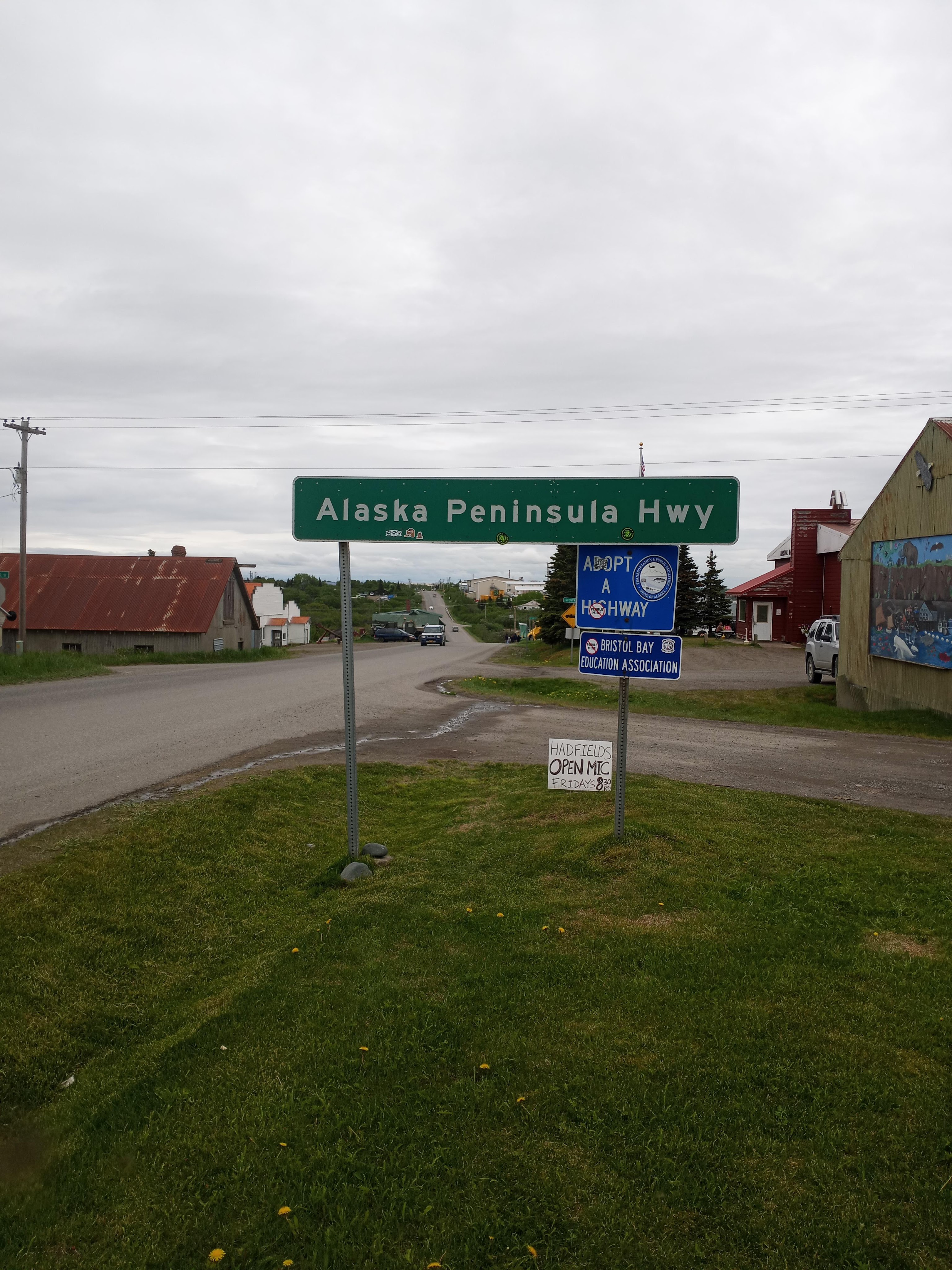
The Alaska Peninsula Highway in “downtown” Naknek.
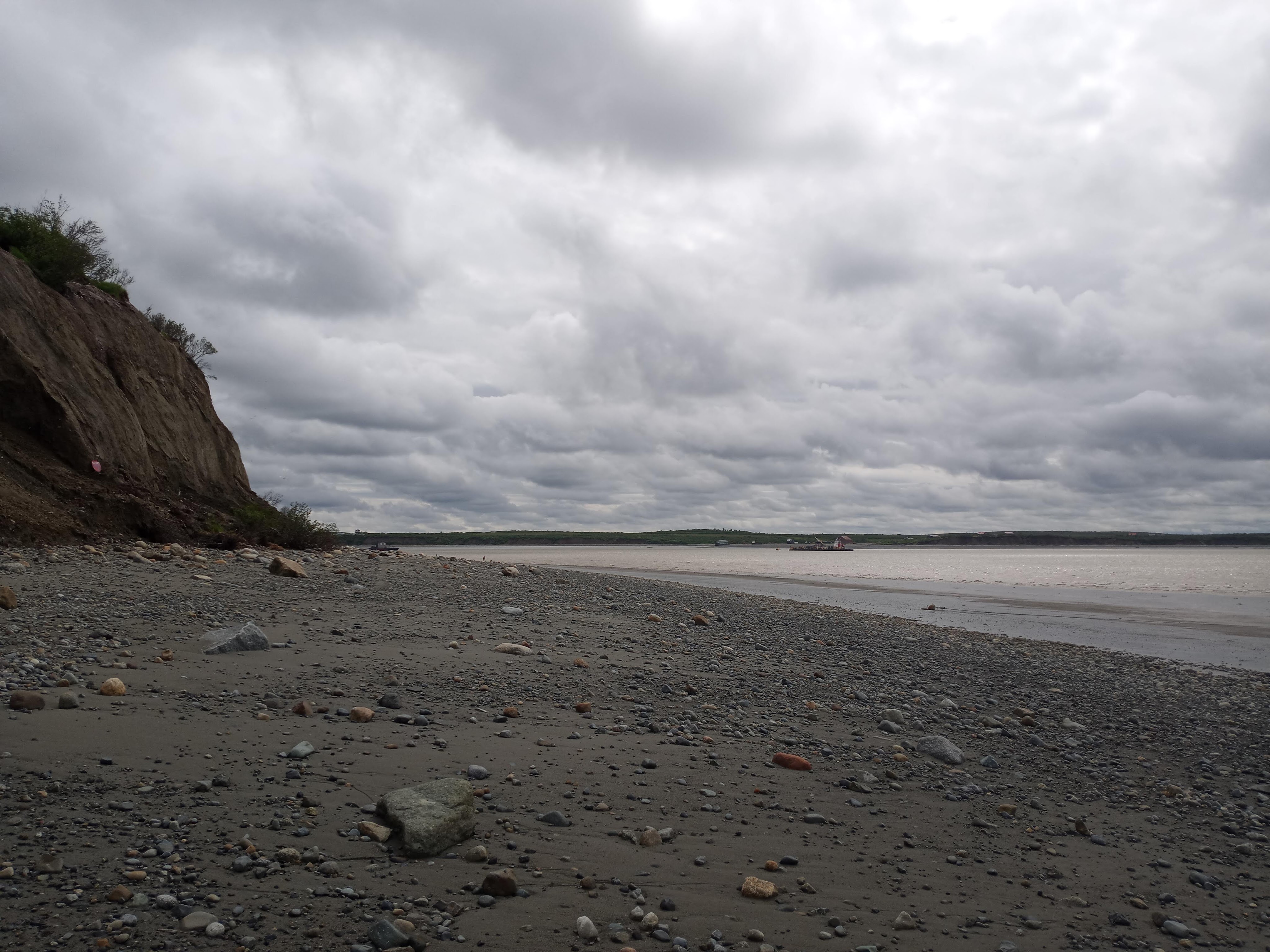
Bristol Bay and lots of rocks.
 Ben Clagett
Love it! Thanks for sharing brother. I hope you’re doing well my man.
LikeLike
Absolutely my an – thanks for reading! I hope you have gotten settled in OK okay – I am sure it is nice to be back around family and the kiddos. Lots of love brother!
LikeLike
Wow!! Yours is a beautifully written and incredible story! When out on the side-by-side bouncing over the Oregon Trail last week, where we three had hiked to Carter, I wondered how you were! And now, this! How incredible that you acted on your adventure streak, and had such a great one— Full of twists and turns and challenges. Finding your Alaskan calming stone was divine intervention, I say. Your strength of mind and body is inspirational. By reading your story, I am now able to some of what my son experienced when he graduated high school and headed up to Valdez, Alaska to work in the fish cannery there for a season. As soon as I received your story piece today I immediately read it to Vic! I am so excited to read the next part! Thank you for sharing this with me!
LikeLike
Hi Jan! Thank you so much for the message. I am happy to hear you’ve been able to tackle more miles on the Oregon Trail. I think back to our overnight trip with Anj often and have such great memories of that experience!
The Alaska calming stone was definitely divine intervention…And in the next few parts I’ll talk more about what role spirituality played in the experience. Spoiler alert – it was a lot! It sounds like your son had an adventure in Valdez, too. All these Alaskan jobs are full of so much potential, challenges, and opportunities for growth. I will always be grateful I had the chance to push my limits in a different capacity.
Thank you for reading and for the kind words, as always! Sending you and Vic lots of love!
Ben
LikeLike
Next chapter please!
LikeLike
Thank you for reading, Anita! I will be posting the next part over the weekend – football permitting!
LikeLike
Talk about getting out of your comfort zone and trying a new experience!! What an adventure. Your skilled writing allowed us to feel that we were right there with you. I sure feel for you as you struggle with anxiety. My youngest son (36) does as well. Sadly, many people don’t understand how debilitating it can be. It is one of those invisible afflictions. We follow Adventure Van Man on YouTube. He has worked this seasonal job several times. We love salmon but had no idea of the hard work it takes to get it to our table. We appreciate it all the more. Looking forward to hearing more of your experience with the salmon 🍣. Always appreciate and enjoy your posts.
Sent from Yahoo Mail for iPad
LikeLike
Hey Bruce! Thank you for the message. It sure was an incredible experience! Thank you for the feedback on my writing. That is very helpful, and I am trying to get better at “painting a picture” of what the adventure looked and felt like, without the aid of as many photos. It is a challenge, but I am happy to hear you felt like you were there by my side.
I am sorry to hear about your son and his anxiety. And you’re right, it is an affliction that can have crippling effects. I am grateful that I have (slowly) learned how to deal with mine. It will always be a battle to some degree, but dealing with it one moment at a time has helped immensely. Sending prayers to your son.
I have not heard of Adventure Van Man but I will check out his page! It sounds like we are cut from the same cloth and I’m sure he had some incredible stories to share. Thank you for reading and for your continued support over the years. It means the world to me! Parts II and III are coming soon!
Lots of love,
Ben
LikeLike
Hi Ben, Thanks so much for sharing your blog regarding your journey to Alaska! What a wonderful adventure! I enjoyed your narrative and the pictures of the Alaska Peninsula Highway, Naknek River and Bristol Bay! It is wonderful that you are keeping a written record of your travels around the various parts of the U.S. In July, I went on a train trip to Glacier National Park. It was sponsored by Osher LifeLong Learning through the University of Minnesota. We had great tours of the area, very pleasant traveling companions and perfect weather! The scenery was magical, almost surreal. Next month, some friends and I are going to Door County Wisconsin for a few days. Should be a good time to see the fall colors! Take care. Keep me posted on your travels! Hi to all. Liz
LikeLike
Ben you are AMAZING the journeys that you go on and your beautiful writings. God Bless You and thank you for sharing your life with us. You make me feel as if I am there. Stay safe & strong my friend. I look forward to reading more of your journey.
LikeLike